
As kids get older, coaches should do less during games.
Less coaching, less driving the energy, less micro-managing of the kid’s play and decisions.
I coached Majors this year and in 20 games, there was not a single instance where I, or the other coach, called out where the play was, reminded the kids how many outs there were, or who the cutoff was. We simply let them play…even in the “big” games during the playoffs.
This allowed them to take ownership of their team, make and learn from their own mistakes, and stay totally focused on current situation on the field.
There was no looking into the dugout after each pitch for instructions or direction; the kids were almost entirely left on their own to play the game.
And it worked; they played with confidence, not fear. They took accountability instead of looking for excuses. They relied on each other for communication and support. I was incredibly proud of them all and the fact that we won the playoffs was just a bonus, although it was absolutely a byproduct of how we as a team approached games from a mental standpoint.
As parents and coaches, I know that’s not easy to do. We want our kids to be successful and we think that we can help them by hollering out instructions or giving them constant advice and reminders. But, especially as kids get older, those well-meaning comments and over-coaching often cause more harm than good.
Micro-managing distracts them from the action in front of them and ultimately robs them of the opportunity to feel like the game is theirs.
Coaches driving the energy prevents them from learning how to be leaders.
Players looking to the staff instead of each other when the going gets tough feel like they don’t have the ability to overcome adversity on their own.
Giving this much autonomy to players doesn’t usually work the younger ages as those kids do need help with the basic decisions, but gradually giving kids more freedom as they get older is an essential piece of their development.
In addition to coaching Maddux’s baseball teams, I always coach his (and Sloane’s) PVYBL basketball teams.
I played 4 years of basketball in High School growing up in DC where my main claim to fame was getting dunked on by THREE different players who would go on to play in the NBA. Roger Mason, Joe Forte, and Keith Bogans. DC was LOADED in basketball talent.
Playing against some of the best prep players in the country was an incredible experience and having a 5-20 record as the starting point guard my senior year definitely built character! I still love the sport and coaching youth basketball is a blast.
During our 6th grade semi-final playoff game in January, Marissa snapped this picture of me on the bench:
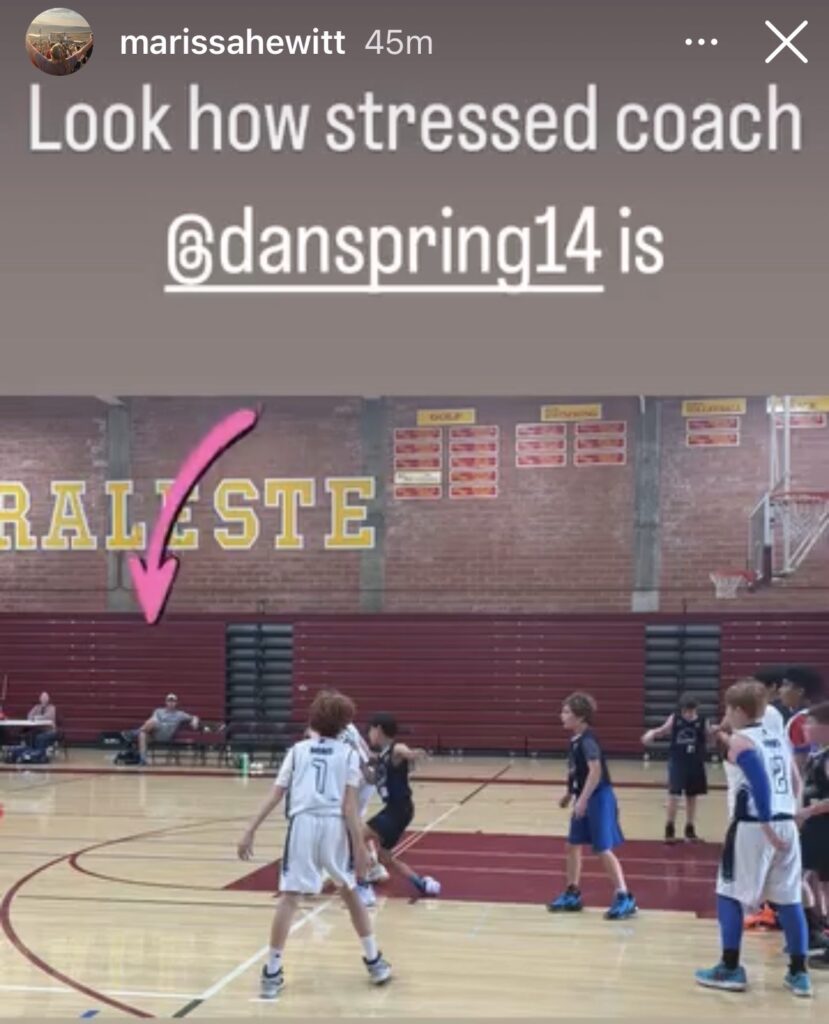
Why was I so relaxed in the 2nd half of a close game? Lots of reasons.
1) I’m watching kids play a game, not Game 7 of the NBA Finals – there’s absolutely nothing to be anxious about.
2) If my players looked towards the bench and saw me nervously pacing, then they would be more likely to start feeling nervous which in turn would have made their performance suffer. More often than not a team’s “temperature” during a game will mirror that of their coaches and I wanted my players feeling relaxed and confident, not nervous and scared…so I modeled that behavior from the bench.
3) Kids playing sports make mistakes, lots of them. So if after a turnover, or a traveling call, or an airball, or an ill-advised foul they saw me get upset and frustrated, then the mistake would be more likely to further upset and frustrate them, making the next play more difficult.
On the other hand, if after a turnover, they looked over to the bench and see me smile and shrug my shoulders, then that’s the end of it; they immediately realize that mistakes are no big deal, they let it go quickly, and turn their attention to hustling back and playing great defense.
My high school baseball coach’s favorite expression in-game when he sensed the team’s mental toughness starting to waver was, “water under the bridge…” and I’ve been trying to model that attitude the best I can ever since I was 15 years old.
4) My kids are getting older and as they mature as humans and athletes they need less instruction and direction during games. In order to truly develop as athletes they need the space and freedom to make decisions on their own, learn from their mistakes, find the desire to work hard and strive to win internally rather than externally, and to play with intensity that originates from the team, not from the coaching staff.
Maddux’s 6th grade basketball team worked hard at our practices and as they continued to be more and more prepared to compete, they needed far less instruction coming from the bench than when they were younger. The most effective coaches prepare their teams during practice so that they can just sit back and watch them perform on game day.
Of course, we can’t just “sit back” and watch tee ballers play; they need help so on the other hand…
Sloane’s 3rd grade team needed a lot more in-game instruction than Maddux’s 6th grade team as some of the girls adorably still forgot which basket to shoot on or what the rules about dribbling were, but a relaxed coaching attitude for them is absolutely still the way to go.
Certainly as kids get older though, coaches should absolutely be doing less during games.
And all that said, my laid-back demeanor when coaching my kids (or watching them from the stands when I’m not coaching) should not be misinterpreted as me not caring!
Of course I care about my kids, and the team’s the play on.
And of course I’d rather they win than lose, but what I really care about most is their attitude, effort, and sportsmanship. I care that they learn to make mistakes, embrace failure as a necessary and healthy part of development, try their hardest, and are great teammates and respectful opponents.
I also want them to play their best. (No parent sits in the stands hoping his kid strikes out four times or shoots 11 straight airballs.) If I have unrealistic expectations and watch them play filled with anxiety about their performance they will absolutely feel the pressure, making it impossible for them to play up to the best of their abilities.
My behavior as a coach and parent is extremely intentional. Every human does their best when they feel relaxed, confident, and supported, not when they feel anxious, nervous, or scared about failure.
Kids learn the most about how to feel about sports, how to manage their own emotions, how to respond to failure, how to stay calm in the “big” moments from the adults in the room; the coaches on the sidelines, and the parents in the stands.
We all have an enormous responsibility to create youth sports environments that make the experience fun and rewarding for kids because it is OUR actions and attitudes as adults that determine what kind of atmosphere exists at a baseball, soccer, basketball, or football game.
Right now I’m coaching Maddux’s 11U All-Star team. I’m positive that the kids will be nervous and anxious at times during our games. We have been practicing hard for weeks and they are ready to play; my main job on game day will be to model a cool, calm, and confident attitude from the dugout and 3rd base coach’s box so that they’re in the best mindset to reach their full potential.
I won’t be screaming “WE GOT TWO OUTS, LET’S GET THIS GUY!!!!” or “COME ON, GUYS, WE’RE DOWN 2 RUNS…WE’VE GOT TO SCORE THIS INNING.”
They know the situation and my anxiety will only add to their own totally natural nervousness.
And like everything with youth sports these days, I think the most important trait for parents and coaches to possess is perspective.
If we win the district tournament or lose 2 games and are out right away, nobody’s lives will change either way.
The coaching staff has worked has hard as we can to prepare them physically and mentally for success and now we’re just going to sit back, relax, and have fun watching them play.
Our first game is on Tuesday; come on out to support the boys (and watch me Zen out from my spot on the bucket in the dugout😁)
ZEN Hard, Have Fun 🙂