
Let’s just be honest; playing outfield during games in Tee Ball, Farm, and most of the time in Minors, can be pretty boring. Rarely does the ball get hit out there and most leagues (correctly) have rules in place against taking extra bases on overthrows so there aren’t opportunities for back-up bases either.
But as soon as kids get to Intermediates (age 9 and 10), outfield starts to become extremely important and then every year after that, it just keeps getting more and more crucial to a team’s success for lots of reasons.
- Hitters start driving the ball into the OF more consistently so there’s more action.
- Backing up bases becomes an absolutely essential part of playing quality team defense.
- While there are SIX players in the IF at all times, there are only THREE players to cover all of the OF! That’s not easy to do and it takes a lot of practice to become a great outfielder.
- An error in the IF usually only costs a team 1 base, while an error in the OF can cost two (or more bases).
Yes, teams need a solid infield, but what I’ve noticed is that by time Majors (age 11 and 12) rolls around, every team has a solid IF and what starts to set teams apart isn’t necessarily the quality of their Shortstop or Catcher, but the quality of their outfielders.
How should we prepare for this developmentally?
First, starting in Minors, coaches should spend a significant amount of practice time on Outfield play.
In Minors, this means beginning the process of getting every player on the team comfortable catching a routine flyball, looking for the cutoff after they have secured the ball, and creating the good habit of moving somewhere (even if it’s wrong) the instant the ball is hit.
Catching flyballs in Minors is often as basic as throwing the ball straight to them from a relatively short distance to help them build some confidence; then as they get more comfortable you can throw the ball higher and then start hitting it from home plate when/if they’re ready.
In Intermediates, we should continue all that skill work, as well as begin to emphasize mentally being ahead of the play for backing up bases and their teammates, in addition to an introduction of taking a correct route with proper footwork to all balls hit into the Outfield.
More advanced Outfield play is all about reading the trajectory of the ball off the bat and then taking good angles to the ball. Beginning to build that database of height and direction in their brains starting around age 9 or 10 is generally the right time developmentally.
By Majors, you should have 3 outfielders who can catch the vast majority of the balls they get to, understand the importance of taking their first step back on flyballs and then working their way in from there, can confidently hit their cutoff with low throws, and more often than not react immediately after the ball is put in play to back up a base (if the ball isn’t hit in their direction).
And here’s the most important thing developmentally; ALL players should get reps in the OF, even players who will likely not play there during games in Little League.
Sport specialization at young ages is a huge problem these days but so is position specialization.
A 12-year-old All Star shortstop might end up being a left-fielder in high school. Why? Because a better shortstop might take the position from him. And if that 12-year-old All Star hasn’t really played any other positions, he’ll have a hard time earning a spot on the field if all he can do is play Shortstop and he ends up being the backup.
As I tell the older kids at camp, you might be the best shortstop in Palos Verdes when you’re 15, but if Mookie Betts moves to PV and his son plays a better shortstop than you do, you better find another position to play or you’ll be riding the pine!
I can tell you the value of playing lots of positions from personal experience.
My freshman year of high school, I was the starting shortstop on JV. After the season ended the varsity head coach told me I was going to be the starting Catcher the next year on Varsity. I had literally never put catcher’s gear on in my life.
But the team had a high school All-American shortstop a year ahead of me (he went on to be inducted into the George Washington University Baseball Hall of Fame) so it was either learn a new position or sit on the bench waiting for him to graduate. I chose to learn a new position.
I was the starting catcher my sophomore, junior, and senior year of high school and after working my butt off, won Gatorade Player of the Year for Washington DC as a Junior and was a high school All-American behind the plate as a Senior.
When I got to Brown, there was a future professional Catcher one year ahead of me so the team found a spot for me as the starting 2nd baseman (knowing I had once been a full-time infielder). Sophomore year I mostly started at 3rd base.
Then towards the end of my 2nd season, I started pitching, while continuing to play infield, Catcher, and outfield as the team needed. In fact, there was one game where I started at 3rd, played RF for 2 innings in order to be physically closer to the bullpen so I could warm-up between innings, and then came in relief to pitch.
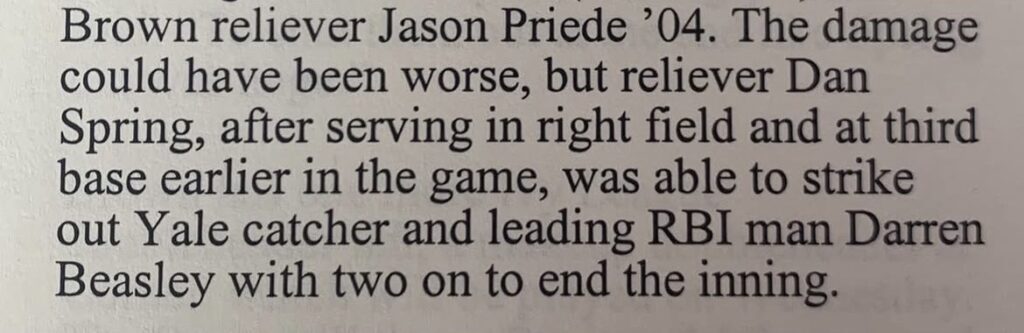
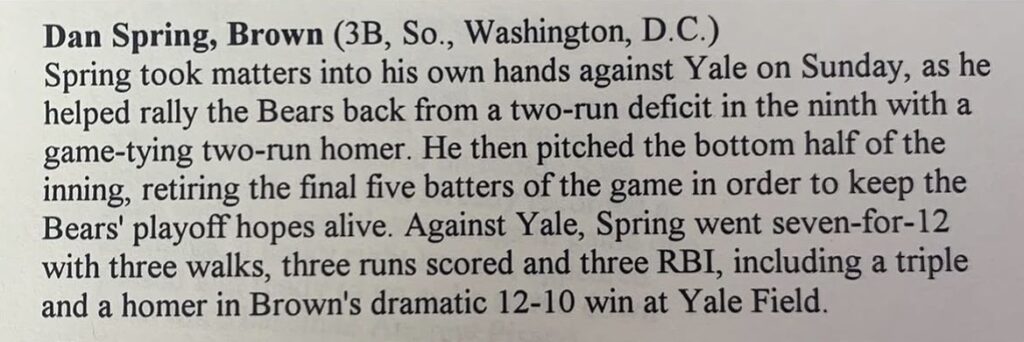
It wasn’t my hitting ability that allowed to me play every game for 4 years in college, it was my versatility!
The only thing I would have changed about my youth baseball experience was getting the opportunity to play more positions when I was younger.
That’s because it’s easier to learn anything when you’re younger and why it’s so important to let kids play as many different positions as possible.
And what’s the absolute best time of the year to learn new positions and try new things? The off-season: Summer and Fall!
At Summer Camp, the kids switch positions literally every inning. Same during my Fall Ball games.
Does putting kids in uncomfortable positions during Summer Camp and Fall Ball games lead to some ugly baseball at times? ABSOLUTELY!
Errors, throwing to the wrong base, backing up the wrong base, wild pitches, and passed balls are all extremely common at first.
But that’s the whole point! When we allow kids to get outside of their comfort zone by creating environments that are more focused on development than on winning, they all build a wider and more diversified set of skills that will ultimately turn them into a better ballplayer as they get older, regardless of what position they end up settling into.
It’s crucial to not simply allow, but actively encourage, risk-taking and failure. That’s when the magic happens!
With only 4 weeks of Summer Camp left and the baseball off-season right around the corner, I would encourage all families and players to use the next several months to develop NEW skills. Try switch hitting. Take a ton of reps at positions you’ve never played before. Throw your new change-up in a game, even if it’s not “ready.”
And if you find yourself in a Fall program that doesn’t encourage this type of growth, experimentation, and failure because putting a picture of winning a $5 plastic ring on Instagram is more important to them than what’s best for your child…go find a program that does!
PLAY HARD, HAVE FUN!